 English
 العربية
 Français
 Deutsch
 Nederlands
 中文
 Русский
When you import food, you import responsibility. Retailers, regulators and consumers expect every product to be safe, legal and traceable. Certifications are the shortcut to that confidence: independent proof that a supplier has the systems in place to deliver consistent, safe food. This article explains the certifications you will meet when buying Egyptian produce — and what they mean in practice.
ISO 22000 — food safety management
ISO 22000 is an international standard for food safety management systems. It combines the principles of HACCP (hazard analysis and critical control points) with management-system requirements such as documented procedures, prerequisite programmes, traceability, emergency preparedness and continual improvement. It applies to any organisation in the food chain — including packers, processors, traders and exporters.
For importers, ISO 22000 means the supplier has systematically identified food safety hazards, controls them and can trace each lot backwards and forwards.
ISO 9001 — quality management
ISO 9001 is the world’s most widely used quality management standard. It focuses on customer requirements, consistent processes, documented responsibilities, corrective actions and continuous improvement. In export trade it translates into clear specifications, reliable order handling and professional complaint management.
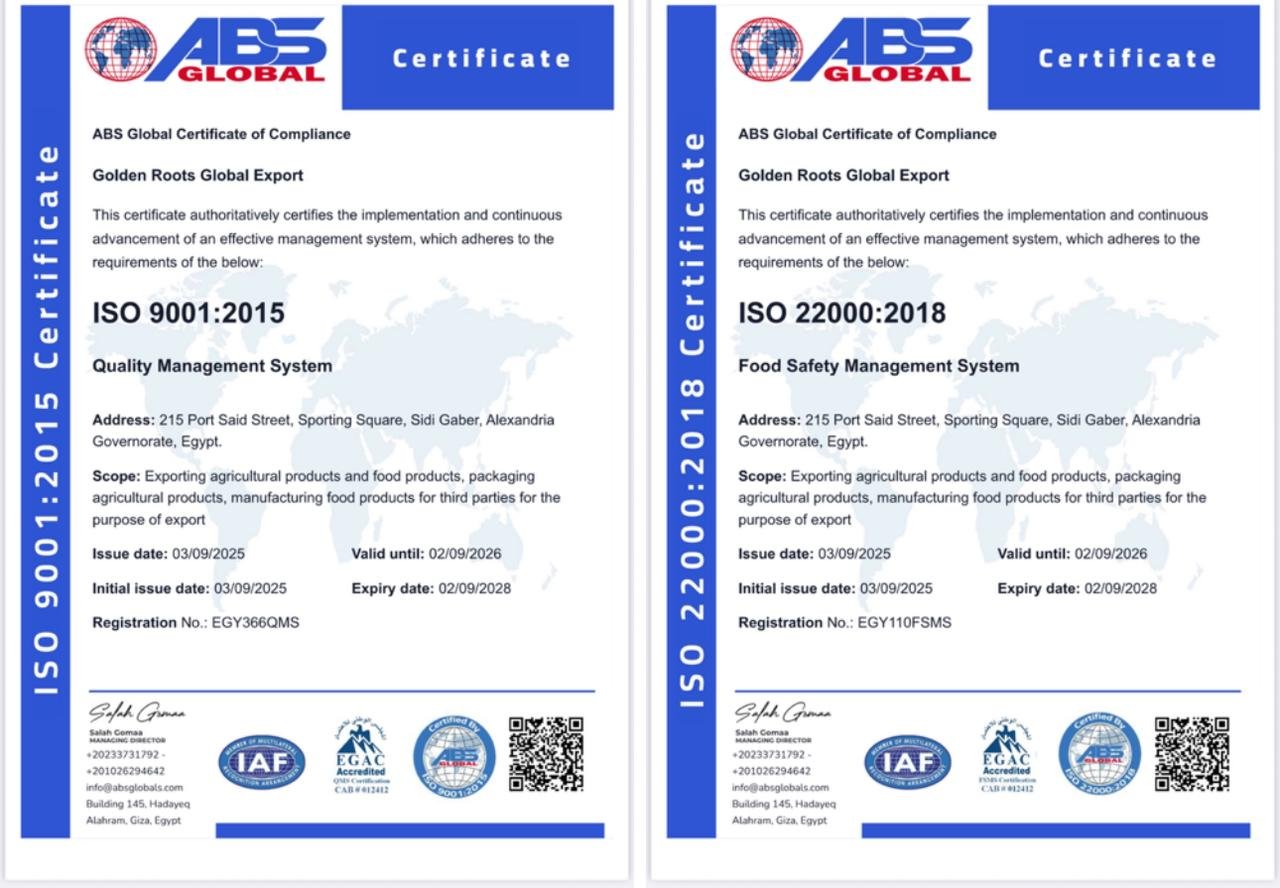
Golden Roots holds ISO 22000:2018 and ISO 9001:2015 certifications, issued by an accredited body and verifiable on the IAF CertSearch database.
GLOBALG.A.P. — good agricultural practice
GLOBALG.A.P. certifies farms. It covers safe use of plant protection products, fertilisers and water, worker health and safety, hygiene during harvest, environmental protection and traceability from the field. Many European retailers require GLOBALG.A.P.-certified growers for fresh produce. Exporters work with certified farms and maintain chain-of-custody so certified product stays identifiable.
HACCP
HACCP is a systematic method for identifying and controlling biological, chemical and physical hazards at critical points in production. It is the foundation of most food safety standards and a legal requirement for food businesses in many countries.
BRCGS and IFS
For processed and frozen products, many retailers ask for GFSI-benchmarked standards such as BRCGS Food Safety or IFS Food at the processing plant. When buying IQF products, ask which standard the processing facility holds.
Maximum residue limits (MRLs)
An MRL is the highest legally tolerated level of a pesticide residue in or on a food. Each market sets its own limits — the EU, the UK, the Gulf states, Russia and others — and imported food must comply with the destination’s MRLs. Exporters manage this through:
- Approved spray programmes and pre-harvest intervals at farm level
- Residue testing by accredited laboratories before shipment
- Traceability so that any issue can be linked to the field and lot
Egypt has invested heavily in residue monitoring for exports, and products can be tested on request against the specific list of active substances your market requires.
Other documents that build trust
- Phytosanitary certificate — issued by Egyptian plant quarantine, confirming the consignment meets the importing country’s plant-health requirements.
- Certificate of origin — proves Egyptian origin and enables preferential duties under trade agreements.
- Lab reports — residues, microbiology, heavy metals or mycotoxins as needed.
- Memberships — Golden Roots is a member of the Agricultural Export Council, Expolink, the Federation of Egyptian Chambers of Commerce and the Alexandria Chamber of Commerce.
How certifications reduce your risk
| Risk | How certification helps |
|---|---|
| Rejection at the border | Residue control and correct phytosanitary documentation |
| Product recalls | Traceability and hazard control under ISO 22000 / HACCP |
| Inconsistent quality | Documented specifications and processes under ISO 9001 |
| Retailer non-compliance | GLOBALG.A.P. at farm level and GFSI standards at processors |
Verify, don’t just trust
Always ask for copies of certificates, check their scope and validity dates, and verify them in the issuing body’s or IAF’s database. A reliable exporter will share this information willingly. Learn more about Golden Roots or request our certificates.
Frequently Asked Questions
Is Golden Roots ISO certified?
Yes. Golden Roots holds ISO 22000:2018 (food safety management) and ISO 9001:2015 (quality management) certifications, verifiable through the IAF database.
What is an MRL?
An MRL (maximum residue limit) is the highest level of a pesticide residue legally tolerated in or on food. The EU, UK, Gulf states and other markets publish their own MRLs, and exporters must comply with those of the destination market.
What is the difference between ISO 22000 and GLOBALG.A.P.?
GLOBALG.A.P. certifies good agricultural practices at farm level, while ISO 22000 covers the food safety management system of the organisation handling, packing and exporting the food.